This Week in Global Logistics

port of shanghaiOakland Officials Reject New Tactics to Combat Protests – Council members rejected calls for stronger tactics to prevent protests from shutting down the Port of Oakland.  In November, and then again in December, protestors from the Occupy movement were able to shut down port operations in Oakland.  The second action was part of a broader push to close all West Coast ports.  Partially due to a much smaller police presence than other ports, Oakland was among the hardest hit by the protests.  Port officials estimated that the December shutdown alone cost the local economy $4 million. Council members are looking for more specific information on the cost of additional police presence before voting again on the matter.

Read more from the JOC.

EU Courts Uphold Airline Carbon Rules – Europe’s highest court dismissed a lawsuit by North American airlines that challenged the European Union’s (EU) new cap-and-trade program.  The program begins on January 1st and is designed to reduce the industry’s carbon emissions.  Under the plan, each airline is issued pollution credits at a rate lower than their historical output.  If an airline exceeds their allotment, they must purchase additional credits; providers that operate under their allowance can sell their excess credits.   According to experts, air traffic is the fastest growing source of carbon emissions.

Read more from the Huffington Post.

Kim Jong-il Death Prompts Questions for Isolated North Korea – The death of North Korean leader Kim Jong-il and transition of power is being watched closely by the world.  The former leader’s youngest son is set to be the successor of one of the most isolated countries in the world.  Neighboring South Korea and China will perhaps be keeping closest tabs on leadership transition.  Most international trade to North Korea passes through China.

Read more from the New York Times.

NORAD Continues 50+ Year Tradition of Tracking Santa – What began as a misprinted telephone number for Santa Claus in a 1955 Sears advertisement has turned into a 56 year tradition of tracking Mr. Claus. The original mistake directed children to call a number that was actually an operations hotline for the Continental Air Defense Command (CONAD). Then Director of Operations, Colonel Harry Shoup, ordered his staff to update kids on Santa’s progress throughout the night and the tradition stuck. Today, the program’s successor, North American Aerospace Defense Command (NORAD) is a joint US/Canadian organization that provides air defense support for the two countries. The Santa tracking program now boasts Facebook and Twitter pages as well as a mobile app.

Read more from NORAD Tracks Santa.


This Week in Global Logistics

Customs Trade Partnership Against TerrorismCustoms Testing New Cargo Entry Process – This week, Customs and Border Protection announced a pilot program that will simplify the U.S. customs entry process for ocean cargo. The program focuses on obtaining entry information earlier in the process, similar to the recently implemented Importer Security Filing (ISF). The pilot project is limited to importers with Tier II or III C-TPAT status. In the future, Customs anticipates expanding the program to include air cargo.

Read more from the JOC.

Maersk’s Launching New Class of Mega-Vessels in 2013 – The world’s biggest container shipping line, Maersk, is slated to launch 20 ships of the new Triple-E class over the next 4 years. With a capacity of 18,000 TEUs each, the new class of vessels will be the largest container ships on the water. The ships are being built in South Korea at a cost of $190 million per vessel. The new fleet is designed to consume less fuel and emit less carbon emissions than container ships now in service.

Read more from Reuters.

Apps Make an Impact in Supply Chain Management (SCM) – An increasing number of supply chain managers are using their handheld smartphones and mobile applications to help in their day-to-day tasks. Application functions that include inventory control, tracking, messaging and timekeeping are proving very useful in the supply chain. With the growing amount of handheld technology and mobile software, SCM apps will improve the ability to manage supply chains from virtually anywhere and make it possible to conduct operational analysis from “the palm of your hand.”

Read more from Supply Chain Digital.

50% of Multinational Companies Choose Green Suppliers – According to a study conducted by the Carbon Trust Advisory (CTA), half of multinational companies plan to select suppliers based on their CO2 emissions. The research also states that approximately one-third of suppliers are in danger of losing existing business due to poor environmental performance. About 60% of multinationals are willing to pay more for suppliers with low emissions to decrease their overall carbon footprint.

Read more from Environmental Leader.

This Week in Global Logistics

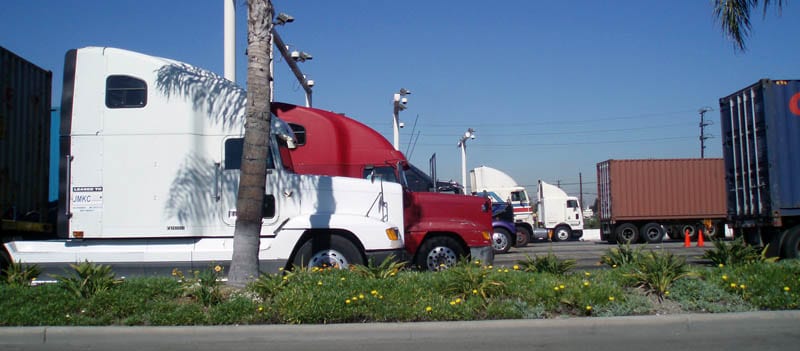
truck in line at portU.S. May Remove Tariffs for Least Developed Countries – The U.S. International Trade Commission is evaluating the impact of eliminating tariffs and quotas on products from the world’s poorest countries.  Although World Trade Organization (WTO) members agreed in 2005 to implement such programs, a final agreement has not yet been reached.  While most of these goods are already imported duty free in the U.S., certain products like textiles and sugar are treated differently in an effort to protect domestic production.

Read more from Reuters.

Plans to Grow LNG Infrastructure – Chesapeake Energy, one of the largest natural gas producers in the U.S., plans on investing $1 billion over the next decade to bolster demand for natural gas.  Initially, they plan to build 150 liquid natural gas (LNG) fueling stations at truck stops across the country.  Compared to current diesel prices, LNG is around $1.50 to $2.00 less per gallon compared to diesel.  LNG also provides significant improvements in carbon monoxide, nitrogen oxide, particulate matter, and other emissions.

Read more from the JOC.

Tokyo Tops List of Most Expensive Cities – The strength of the Japanese Yen ensured that Tokyo would remain in the top position of the Economist Intelligence Unit’s worldwide cost of living report.  Australian cities generally moved up in the rankings and Europe accounted for half of the list in the top 50.  Although several Chinese cities dropped in the rankings, Shanghai now ranks well above New York in the list.

Read more from CNN.

Proposal for Maritime Carbon Standards – The World Shipping Council together with officials in Japan have created a plan to regulate vessel efficiency and penalize carriers that don’t meet the new requirements.  The plan was submitted to the International Maritime Organization (IMO) and is designed to incentivize steamship lines to operate the most efficient vessels possible.

Read more about the report from the World Shipping Council.

This Week in Global Logistics

Collapsible Cargo Container Being Tested – A new collapsible container design is being developed by the Dutch company Cargoshell.  The new container is made of lightweight composite materials and, according to the manufacturer, can be broken down by one person in 30 seconds.  This collapsed footprint takes only one fourth of the space compared to a standard container.  Due to the smaller footprint and lighter weight, the container is designed to save energy during transport and handling.

Learn more from Eye for Transport.

port of long beach green

Challenges to Europe’s Cap-and-Trade Policy – In 2012, the European Union (E.U.) plans to include all airlines that take off or land in Europe in their Emissions Trading System (ETS).  Under the plan, airlines will becharged the entire cargo emissions of their plane’s routes, even those outside of E.U. airspace.  This has many U.S. airlines and lawmakers claiming that the plan would violate international law.  The legality of this plan is currently being evaluated by the highest court in the E.U.  .

Learn more from the New York Times.

US-Mexico Agree on Trucking Pact – A new cross-border trucking agreement was finalized that will end punitive tariffs implemented by Mexico on certain U.S. products.  These tariffs, which amounted to $2.4 billion, were implemented as a result of a breakdown in the previous agreement.  U.S. exports welcomed the news while many U.S. truckers and labor groups continue to raise concerns about competition as well as the safety and oversight of the Mexican trucks.

Learn more from the JOC.

China Eases Barriers for Foreign Vendors – The Chinese government has softened its stance on foreign entities bidding for technology or energy contracts.  This comes as welcome news to firms in Europe and the U.S. as these contracts amount to approximately $1 trillion annually.

Learn more from the About.com Logistics/Supply Chain blog.


© 2013 Dedola Global Logistics
3822 Katella Avenue
Los Alamitos, California 90720
800.743.2305